
The Truth About Hormone Replacement Therapy (HRT): What Science Really Says

Maybe you've brought it up to your doctor and been brushed off. Maybe you've been too nervous to even ask. Or maybe every time you try to research it, you walk away more confused than when you started one article swears it's dangerous, the next calls it a miracle, and you're left not knowing who to trust.
I get it. HRT might be the most fear-loaded, confusing topic in all of perimenopause. And nearly all of that fear traces back to a single study, handed to you with no context, more than twenty years ago. So let's clear it up, calmly, with the actual science.
"HRT is not the dangerous treatment many of us were taught to fear the early research was misinterpreted, miscommunicated, and applied to women it never actually studied."
For more than 20 years, women have been scared away from hormone replacement therapy because of a single study the Women's Health Initiative (WHI) and the way it was presented to the public. Headlines told women HRT caused breast cancer, heart disease, and strokes. Doctors stopped prescribing it. Women stopped asking for help. And a generation of women suffered unnecessarily.
But here's the truth: the WHI was conducted on women who were, on average, 63 years old decades older than the women in perimenopause who actually benefit most from HRT. That context was never explained to the public.
Today, we know much more. We know that when HRT is used in the right window (perimenopause or early menopause), the risks are dramatically different and in many cases, the benefits are substantial.
But understanding the science around HRT often leads women to a bigger question like:
"What does my body actually need right now?"
The challenge is that perimenopause symptoms don't all come from the same source. They can stem from fluctuating estrogen, declining progesterone, disrupted sleep, changes in your stress response, or shifts in blood sugar regulation.
If you're asking this question and not sure where to start, take my "What Support Does My Body Need in Perimenopause?" quiz. It takes about a minute and helps point you toward the area your body may need support most right now.
If you just took the quiz, you may already be seeing that supporting your body during perimenopause isn't always about one single solution.
Hormone therapy can absolutely be part of the conversation for some women, but it's only one piece of the bigger picture. Lifestyle, sleep, stress regulation, blood sugar balance, and nervous system support all play important roles in how we feel during this transition.
The challenge is that for more than two decades, many women were discouraged from even discussing hormone therapy because of the way one major study was presented to the public.
Which brings us to the study that changed everything.
What was the WHI and why did it create so much fear?
The WHI, published in 2002, was one of the largest studies ever done on hormone therapy, but here's the crucial detail: the study population did not represent the women actually seeking HRT for perimenopause.
Women in the WHI were:
Mostly in their 60s and 70s
Often 10–20+ years past menopause
Had existing health risks (like higher rates of heart disease)
This matters deeply, because starting HRT in your 60s is not the same as starting it in your 40s during active hormone decline. Hormone receptors, vascular health, and baseline risk are completely different.
Was the study misunderstood?
Yes, massively. The media reported relative risk instead of absolute risk, which made the numbers sound terrifying. For example:
Women heard:
"HRT increases breast cancer risk by 26%."
The truth?
That 26% increase was based on 8 additional cases per 10,000 women per year and it was seen only in one group, using one specific type of therapy (synthetic progestin) in older women long past menopause.
This kind of nuance is exactly what was missing from the original headlines — and why so many women are still unsure what information to trust today.
How did this impact women?
Doctors stopped prescribing HRT. Women stopped asking. Medical schools offered little menopause training. And an entire generation of women especially women in their 40s and 50s were left suffering without evidence-based relief.
How Has the Science Changed Since Then?
Have we re-evaluated the data?
Yes, extensively. Reanalysis shows:
Women who start HRT within 10 years of menopause have lower risks and many possible benefits
Younger women (40s–50s) showed reduced risk of heart disease
Estrogen-only therapy in the WHI showed no increased breast cancer risk and even a reduced risk
The highest risks occurred in older women who started HRT well after menopause
What about the FDA black box warning?
For decades, the FDA's black box warning on HRT scared doctors and patients despite more recent evidence showing the risks were overstated for younger women.
In 2025, the FDA removed this boxed warning after acknowledging that:
The science had evolved
Risks differ dramatically based on age and timing
Women deserve accurate information and thoughtful conversations about HRT
This is a major step toward empowering women to make informed choices.
How Has the Lack of Perimenopause & Menopause Education Affected Women?
Why weren't doctors trained in perimenopause and menopause?
Because for decades, menopause wasn't considered a health priority. It was treated as a normal life stage rather than a transition requiring deeper medical understanding. Perimenopause has been even more overlooked.
Most medical schools:
Provided little to no training on perimenopause or menopause
Focused on the WHI study without much updated context
Rarely discussed the early symptoms women experience
As a result, many providers still rely on outdated information. And women are often left trying to connect the dots themselves, especially when the symptoms don't immediately look like menopause.
Things like sleep changes, mood shifts, and increased stress sensitivity are often some of the first clues. If those sound familiar, you may also find these helpful:
How does diversity play into this?
Women especially women of color have been historically underrepresented in research. Most medical research was done on white men, who do not go through menopause or perimenopause. That means:
Medication responses differ
Symptom patterns differ
Risks differ
Data is incomplete
This is slowly improving, but women deserve transparency about the research gaps.
How Do Hormones Change in Perimenopause and How Can HRT Help?
What is actually happening inside your body?
Perimenopause is not a gentle decline it's a hormone roller coaster. Estrogen and progesterone:
Spike high one month
Drop the next
Become unpredictable
This impacts your mood, sleep, metabolism, brain function, stress response, menstrual cycles, bone density, heart health, and vaginal and urinary health.
How can HRT help?
HRT replaces the hormones your body is struggling to regulate. Depending on the woman, HRT may:
Reduce hot flashes and night sweats
Improve sleep
Stabilize mood
Reduce anxiety
Improve brain clarity
Support metabolism and insulin sensitivity
Protect bone density
Support cardiovascular health
Improve vaginal dryness and painful intercourse
Do all women need HRT?
No. But all women deserve accurate information so they can make a decision with their doctor not out of fear or misinformation.
There are women who cannot or should not use HRT due to medical history. There are also options like low-dose vaginal estrogen, progesterone alone, or non-hormonal treatments. What matters is individualized care.
What Are the Real Risks Today, With Updated Science?
So… is HRT safe?
For healthy women in perimenopause or early menopause, the data shows:
Low-dose transdermal estrogen has a low clotting risk
Micronized progesterone is considered safer than synthetic progestins
Starting HRT early is safer than starting it late
Estrogen-only therapy has the lowest risk profile
The key is personalized care, not broad fear-based recommendations.
How Do I Know If HRT Is Right for Me?
Where should a woman start?
The first step is understanding what symptoms you're actually experiencingand what may be driving them.
Start here:
Take the quiz — Discover what type of support your body may need most right now.
Download the Perimenopause Action Plan— Track your symptoms, understand your hormone patterns, and prepare for conversations with your doctor.
Continue exploring the blog— Understanding perimenopause is a process, and the more you learn about your body, the more confident you'll feel advocating for your care.
Knowledge is power. And you deserve to have all of it.
Final Thoughts
HRT is not the enemy. Misinformation is.
You deserve the whole truth not the headlines from 20 years ago. Not fear-based messaging. Not silence.
You deserve clarity, science, and real options.
And now you finally have the truth you should have been given years ago.
So here's your next step.
You don't have to figure out whether HRT or anything else is right for you all at once. Start by getting clear on what your body is actually asking for right now.
→ Take the free 1-minute quiz:What Support Does My Body Need in Perimenopause?
→ Download the free Perimenopause Action Planso you can walk into your next appointment prepared, not dismissed.
And if you want this kind of straight-talk, science-backed support every week, join my newsletter no fear, no fluff, just the truth you should've had years ago.
Keep reading:

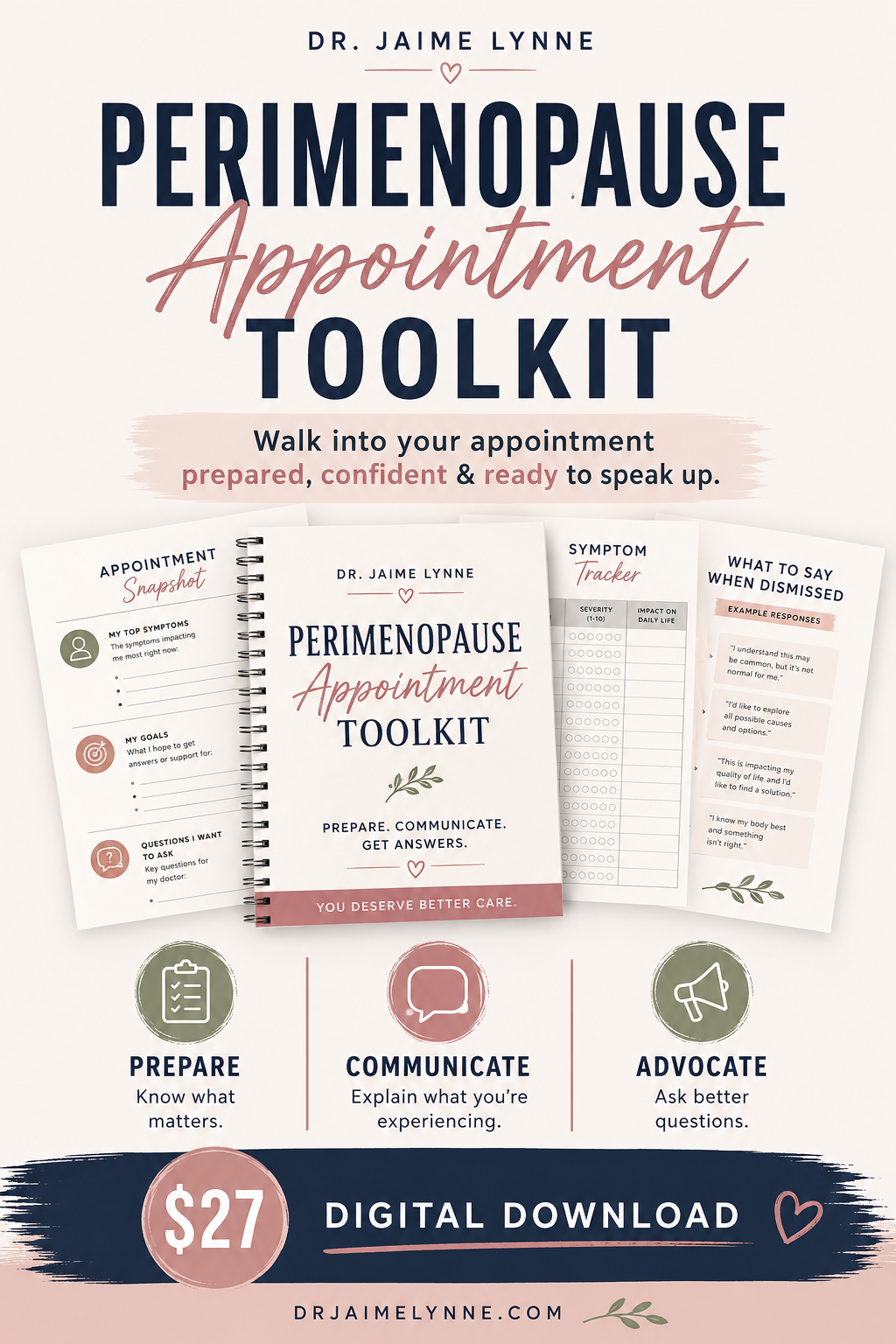
A practical, step-by-step toolkit to help you prepare for your appointment, communicate your symptoms clearly, ask the right questions, and leave feeling heard with a plan for what comes next.