

Perimenopause Symptoms Explained
Perimenopause symptoms explained in clear, science-backed language. Learn what’s normal, what’s not, and why your body feels so different.
What’s Normal, What’s Not, and Why You Feel So Off.
You already know something is off. You're not here looking for permission to feel that way, you're here for answers.
This post is designed to be your reference guide. The one you bookmark, come back to, and share with a friend who's nodding along to everything you've been feeling. We're going deeper than a symptom checklist for each one, we're talking about why it's happening in your body and what you can actually do about it.
Because once you understand the why, the symptoms stop feeling random. And that shift from confusion to clarity changes everything.
Want to know which symptoms are most relevant to your body right now? The quiz takes 2 minutes and gives you a personalized starting point.
First: Why Perimenopause Symptoms Feel So Random
Perimenopause symptoms aren't random they just feel that way because most of us were never taught what's actually driving them.
During perimenopause, estrogen and progesterone don't decline in a clean, predictable slope. They fluctuate sometimes dramatically before eventually settling at menopause. One month estrogen surges higher than normal. The next it drops sharply. Progesterone often declines earlier and more steadily, removing the natural calming effect it used to provide.
Those fluctuations touch your brain chemistry, your nervous system, your metabolism, your sleep, your joints, your skin, and your cardiovascular system. Which is why perimenopause can feel like twenty different things are going wrong at once when really, it's one hormonal transition rippling through your whole body.
This phase can last anywhere from four to ten years. Symptoms often begin years before your period becomes irregular, which is why so many women are told "your labs look fine" while feeling anything but.
The Most Common Perimenopause Symptoms (And Why They Happen)
Fatigue and Low Energy
What it feels like: Not just tired bone-deep exhausted. You sleep and wake up still depleted. You hit a wall mid-afternoon that no amount of coffee touches.
Why it happens: Disrupted sleep from hormonal shifts means you're rarely getting the restorative rest your body needs. On top of that, blood sugar fluctuations from changing estrogen levels create energy crashes throughout the day. Your body is also working harder than usual to manage hormonal chaos that has a metabolic cost.
What helps: Prioritizing sleep quality over quantity, stabilizing blood sugar through protein-forward meals, and strength training to rebuild metabolic resilience.
Sleep Problems
What it feels like: Trouble falling asleep, waking at 3am unable to get back to sleep, or sleeping a full night and still feeling exhausted.
Why it happens: Progesterone has a sedative, calming effect and it's often the first hormone to decline significantly in perimenopause. Less progesterone means a nervous system that can't downregulate the way it used to. Add fluctuating estrogen (which regulates your body's temperature control and sleep architecture) and night sweats, and sleep becomes genuinely difficult.
What helps: Magnesium glycinate before bed, a consistently cool and dark room, eliminating screens an hour before sleep, and waking at the same time daily to anchor your circadian rhythm.
Sleep disruption in perimenopause deserves its own deep dive. 👉 Read: Why Perimenopause Wrecks Your Sleep and What to Do About It →
Mood Changes, Anxiety, and Irritability
What it feels like: Feeling emotionally raw, snapping at people you love, crying over things that wouldn't have touched you before, or carrying a low hum of anxiety that won't quit.
Why it happens: Estrogen directly supports serotonin and dopamine your brain's primary mood-regulating chemicals. When estrogen fluctuates, those chemicals fluctuate with it. Meanwhile, declining progesterone removes a natural source of calm from your nervous system. The result is a brain that is genuinely less chemically equipped to regulate emotion than it used to be.
What helps: Nervous system regulation practices (breathwork, walking, adequate sleep), reducing caffeine and alcohol, and speaking with both your doctor and a therapist if anxiety is significantly disrupting your daily life.
Mood changes and mental health shifts in perimenopause are more connected than most people realize. 👉 Read: Mental Health Changes and Perimenopause →
Brain Fog
What it feels like: Forgetting names mid-sentence. Losing your train of thought. Reading the same paragraph three times. Feeling mentally slower than you used to and noticing it.
Why it happens: Estrogen plays a direct role in cognitive function, memory, and the speed of neural signaling. When levels fluctuate, so does your mental clarity. Poor sleep compounds this significantly. Many women describe brain fog as one of the most unsettling symptoms because it feels so unfamiliar.
What helps: Blood sugar stability, quality sleep, regular aerobic movement (which supports brain health), and reducing the cognitive load on your plate where possible.
Weight Gain Especially Around the Belly
What it feels like: Gaining weight without changing what you eat. Fat shifting to your midsection in a way that feels sudden and stubborn. Nothing that used to work working anymore.
Why it happens: Declining estrogen changes where your body prefers to store fat shifting it from hips and thighs to the abdomen. At the same time, insulin resistance becomes more common, meaning your cells are less efficient at processing carbohydrates. Muscle loss from declining testosterone slows your metabolism further. And elevated cortisol from poor sleep drives additional belly fat storage.
What helps: Significantly increasing protein intake, strength training over chronic cardio, blood sugar management, and treating sleep as a metabolic priority, not a luxury.
This one deserves a full post because there's a lot more to it than just eating less. 👉 Read: Perimenopause and Weight Gain: Why It Happens and What You Can Do →
Hot Flashes and Night Sweats
What it feels like: A sudden wave of heat sometimes intense, sometimes brief that can leave you flushed, sweating, and then chilled. At night, this often means waking up soaked.
Why it happens: Estrogen helps regulate your body's internal thermostat. When levels fluctuate, the hypothalamus (your brain's temperature control center) becomes hypersensitive interpreting normal body temperature as overheating and triggering a cooling response that isn't actually needed.
What helps: Keeping your sleep environment cool, wearing breathable fabrics, reducing alcohol and spicy foods (common triggers), and discussing hormone therapy options with your provider if they're significantly impacting your quality of life.
Irregular or Changing Periods
What it feels like: Cycles that are shorter or longer than usual, heavier or lighter flow, spotting between periods, or increasingly unpredictable timing.
Why it happens: As your ovaries produce less consistent hormones, ovulation becomes irregular. Without the hormonal coordination that used to govern your cycle, the timing and nature of your period changes sometimes dramatically from month to month.
What helps: Tracking your cycle carefully. Any very heavy bleeding, bleeding between periods, or sudden changes should always be discussed with your provider to rule out other causes.
Low Motivation and Feeling Flat
What it feels like: Losing interest in things that used to excite you. Feeling like your drive, spark, or sense of purpose has dimmed without explanation.
Why it happens: Testosterone often overlooked in women is responsible for motivation, mental drive, libido, and energy. It declines gradually throughout perimenopause, and because the change is subtle, many women don't connect it to how they feel until they look back.
What helps: Strength training (which supports testosterone naturally), adequate protein, quality sleep, and a conversation with your provider about whether testosterone levels are worth checking.
The Less-Talked-About Symptoms (That Are Still Very Real)
These are the ones that catch women completely off guard because nobody warned them.
Heart palpitations — Estrogen regulates your autonomic nervous system. When it fluctuates, that system can misfire, causing a racing or fluttering heart that has nothing to do with cardiac disease. Always rule out heart issues first, but know that hormone-related palpitations are extremely common.
Joint pain and stiffness — Estrogen has anti-inflammatory properties and supports joint lubrication. As it declines, stiffness and achiness move in often mistaken for early arthritis.
Headaches and migraines — Estrogen fluctuations are a well-established migraine trigger. If your headaches have gotten worse or more frequent, hormones are likely a contributing factor.
Digestive changes and bloating — Estrogen and progesterone both influence gut motility. Hormonal shifts can slow digestion, increase bloating, and make your gut more reactive than it used to be.
Skin changes — Estrogen supports collagen and skin hydration. As levels fluctuate, skin can become drier, thinner, itchier, or more sensitive seemingly overnight.
Increased sensitivity to stress — Progesterone's calming effect on the nervous system is largely gone. Things that used to roll off you now land harder. This is biochemical, not a character flaw.
There are even more symptoms that most providers never connect to perimenopause. 👉 Read: 9 Commonly Overlooked Symptoms of Perimenopause →
How Do You Know If It's Perimenopause or Something Else?
This is one of the most important questions to sit with because perimenopause symptoms can mimic thyroid dysfunction, autoimmune conditions, depression, and more. Other conditions can also exist alongside perimenopause.
Perimenopause symptoms tend to:
Show up gradually and build over time
Fluctuate week to week or month to month
Cluster together rather than appear in isolation
Stop responding to things that used to work
Correlate with your cycle or hormonal patterns
That said, never let anyone (including yourself) automatically attribute everything to perimenopause without ruling out other causes. Tracking your symptoms carefully and bringing that record to your provider is the most important thing you can do.
One blood draw rarely tells the full story because hormone levels fluctuate so much. Patterns over time matter far more than a single number.
There's No One-Size-Fits-All Answer — And That's Why You Feel Stuck
Most women in perimenopause aren't struggling because they're not trying hard enough. They're struggling because they're getting generic advice for a deeply individual transition.
What helps one woman's sleep won't necessarily help yours. What moves the needle on weight for one body may do nothing for another. Effective support in perimenopause has to be targeted to your symptom pattern — not a protocol designed for someone else.
That's the whole reason I built the Perimenopause Support Hub a program specifically for women navigating this transition who are done guessing and ready for a clear, structured, supported path forward. Clarity on your hormones, confidence in advocating for yourself, practical tools that actually match your body, and a community of women who get it.

Your Next Step
If this post helped things click into place, here's where to go from here:
Get your personalized starting point:
Walk into your next appointment prepared:

Keep reading these posts go deeper on specific symptoms:
👉 Perimenopause and Weight Gain: Why It Happens and What You Can Do
👉 9 Commonly Overlooked Symptoms of Perimenopause
Want Ongoing Support?
Join my weekly newsletter for science-backed symptom breakdowns, hormone education, and practical strategies delivered straight to your inbox. No fluff, no overwhelm, just clarity.

You're not falling apart. You're not imagining it. Your body is in a real transition and understanding it is the first step to feeling like yourself again.

Hi, I’m Dr. Jaime Lynne
A women’s health advocate and educator passionate about helping women navigating the confusing and often overlooked journey of perimenopause. Through my work and resources, I empower women to recognize their symptoms, speak up, and get the care they deserve.
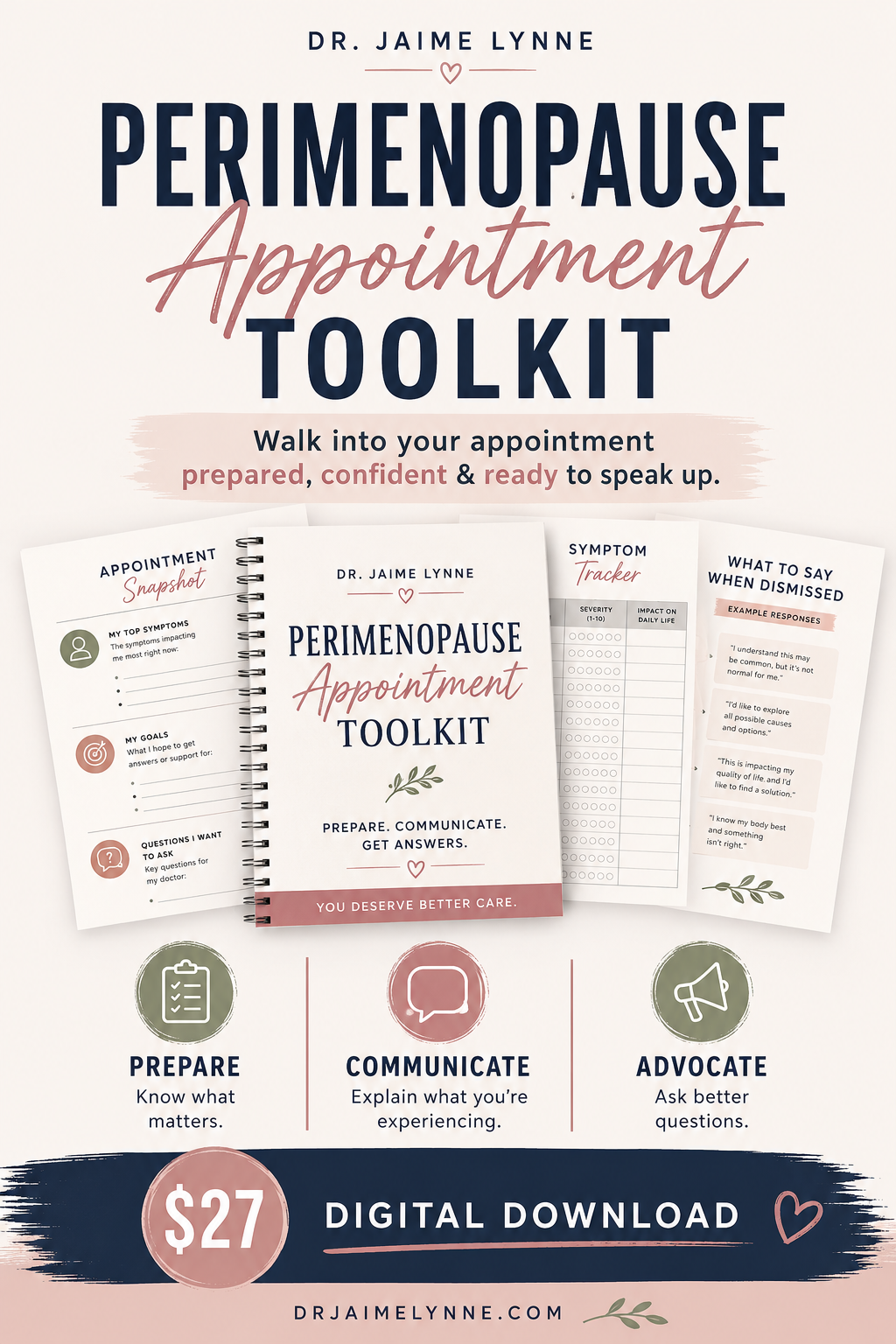
A practical, step-by-step toolkit to help you prepare for your appointment, communicate your symptoms clearly, ask the right questions, and leave feeling heard with a plan for what comes next.

The Truth About Hormone Replacement Therapy (HRT): What Science Really Says
Find out whether HRT is safe, what science shows about hormone therapy for perimenopause, and how updated research changes treatment options for women.

Maybe you've brought it up to your doctor and been brushed off. Maybe you've been too nervous to even ask. Or maybe every time you try to research it, you walk away more confused than when you started one article swears it's dangerous, the next calls it a miracle, and you're left not knowing who to trust.
I get it. HRT might be the most fear-loaded, confusing topic in all of perimenopause. And nearly all of that fear traces back to a single study, handed to you with no context, more than twenty years ago. So let's clear it up, calmly, with the actual science.
"HRT is not the dangerous treatment many of us were taught to fear the early research was misinterpreted, miscommunicated, and applied to women it never actually studied."
For more than 20 years, women have been scared away from hormone replacement therapy because of a single study the Women's Health Initiative (WHI) and the way it was presented to the public. Headlines told women HRT caused breast cancer, heart disease, and strokes. Doctors stopped prescribing it. Women stopped asking for help. And a generation of women suffered unnecessarily.
But here's the truth: the WHI was conducted on women who were, on average, 63 years old decades older than the women in perimenopause who actually benefit most from HRT. That context was never explained to the public.
Today, we know much more. We know that when HRT is used in the right window (perimenopause or early menopause), the risks are dramatically different and in many cases, the benefits are substantial.
But understanding the science around HRT often leads women to a bigger question like:
"What does my body actually need right now?"
The challenge is that perimenopause symptoms don't all come from the same source. They can stem from fluctuating estrogen, declining progesterone, disrupted sleep, changes in your stress response, or shifts in blood sugar regulation.
If you're asking this question and not sure where to start, take my "What Support Does My Body Need in Perimenopause?" quiz. It takes about a minute and helps point you toward the area your body may need support most right now.
If you just took the quiz, you may already be seeing that supporting your body during perimenopause isn't always about one single solution.
Hormone therapy can absolutely be part of the conversation for some women, but it's only one piece of the bigger picture. Lifestyle, sleep, stress regulation, blood sugar balance, and nervous system support all play important roles in how we feel during this transition.
The challenge is that for more than two decades, many women were discouraged from even discussing hormone therapy because of the way one major study was presented to the public.
Which brings us to the study that changed everything.
What was the WHI and why did it create so much fear?
The WHI, published in 2002, was one of the largest studies ever done on hormone therapy, but here's the crucial detail: the study population did not represent the women actually seeking HRT for perimenopause.
Women in the WHI were:
Mostly in their 60s and 70s
Often 10–20+ years past menopause
Had existing health risks (like higher rates of heart disease)
This matters deeply, because starting HRT in your 60s is not the same as starting it in your 40s during active hormone decline. Hormone receptors, vascular health, and baseline risk are completely different.
Was the study misunderstood?
Yes, massively. The media reported relative risk instead of absolute risk, which made the numbers sound terrifying. For example:
Women heard:
"HRT increases breast cancer risk by 26%."
The truth?
That 26% increase was based on 8 additional cases per 10,000 women per year and it was seen only in one group, using one specific type of therapy (synthetic progestin) in older women long past menopause.
This kind of nuance is exactly what was missing from the original headlines — and why so many women are still unsure what information to trust today.
How did this impact women?
Doctors stopped prescribing HRT. Women stopped asking. Medical schools offered little menopause training. And an entire generation of women especially women in their 40s and 50s were left suffering without evidence-based relief.
How Has the Science Changed Since Then?
Have we re-evaluated the data?
Yes, extensively. Reanalysis shows:
Women who start HRT within 10 years of menopause have lower risks and many possible benefits
Younger women (40s–50s) showed reduced risk of heart disease
Estrogen-only therapy in the WHI showed no increased breast cancer risk and even a reduced risk
The highest risks occurred in older women who started HRT well after menopause
What about the FDA black box warning?
For decades, the FDA's black box warning on HRT scared doctors and patients despite more recent evidence showing the risks were overstated for younger women.
In 2025, the FDA removed this boxed warning after acknowledging that:
The science had evolved
Risks differ dramatically based on age and timing
Women deserve accurate information and thoughtful conversations about HRT
This is a major step toward empowering women to make informed choices.
How Has the Lack of Perimenopause & Menopause Education Affected Women?
Why weren't doctors trained in perimenopause and menopause?
Because for decades, menopause wasn't considered a health priority. It was treated as a normal life stage rather than a transition requiring deeper medical understanding. Perimenopause has been even more overlooked.
Most medical schools:
Provided little to no training on perimenopause or menopause
Focused on the WHI study without much updated context
Rarely discussed the early symptoms women experience
As a result, many providers still rely on outdated information. And women are often left trying to connect the dots themselves, especially when the symptoms don't immediately look like menopause.
Things like sleep changes, mood shifts, and increased stress sensitivity are often some of the first clues. If those sound familiar, you may also find these helpful:
How does diversity play into this?
Women especially women of color have been historically underrepresented in research. Most medical research was done on white men, who do not go through menopause or perimenopause. That means:
Medication responses differ
Symptom patterns differ
Risks differ
Data is incomplete
This is slowly improving, but women deserve transparency about the research gaps.
How Do Hormones Change in Perimenopause and How Can HRT Help?
What is actually happening inside your body?
Perimenopause is not a gentle decline it's a hormone roller coaster. Estrogen and progesterone:
Spike high one month
Drop the next
Become unpredictable
This impacts your mood, sleep, metabolism, brain function, stress response, menstrual cycles, bone density, heart health, and vaginal and urinary health.
How can HRT help?
HRT replaces the hormones your body is struggling to regulate. Depending on the woman, HRT may:
Reduce hot flashes and night sweats
Improve sleep
Stabilize mood
Reduce anxiety
Improve brain clarity
Support metabolism and insulin sensitivity
Protect bone density
Support cardiovascular health
Improve vaginal dryness and painful intercourse
Do all women need HRT?
No. But all women deserve accurate information so they can make a decision with their doctor not out of fear or misinformation.
There are women who cannot or should not use HRT due to medical history. There are also options like low-dose vaginal estrogen, progesterone alone, or non-hormonal treatments. What matters is individualized care.
What Are the Real Risks Today, With Updated Science?
So… is HRT safe?
For healthy women in perimenopause or early menopause, the data shows:
Low-dose transdermal estrogen has a low clotting risk
Micronized progesterone is considered safer than synthetic progestins
Starting HRT early is safer than starting it late
Estrogen-only therapy has the lowest risk profile
The key is personalized care, not broad fear-based recommendations.
How Do I Know If HRT Is Right for Me?
Where should a woman start?
The first step is understanding what symptoms you're actually experiencingand what may be driving them.
Start here:
Take the quiz — Discover what type of support your body may need most right now.
Download the Perimenopause Action Plan— Track your symptoms, understand your hormone patterns, and prepare for conversations with your doctor.
Continue exploring the blog— Understanding perimenopause is a process, and the more you learn about your body, the more confident you'll feel advocating for your care.
Knowledge is power. And you deserve to have all of it.
Final Thoughts
HRT is not the enemy. Misinformation is.
You deserve the whole truth not the headlines from 20 years ago. Not fear-based messaging. Not silence.
You deserve clarity, science, and real options.
And now you finally have the truth you should have been given years ago.
So here's your next step.
You don't have to figure out whether HRT or anything else is right for you all at once. Start by getting clear on what your body is actually asking for right now.
→ Take the free 1-minute quiz:What Support Does My Body Need in Perimenopause?
→ Download the free Perimenopause Action Planso you can walk into your next appointment prepared, not dismissed.
And if you want this kind of straight-talk, science-backed support every week, join my newsletter no fear, no fluff, just the truth you should've had years ago.
Keep reading:
A practical, step-by-step toolkit to help you prepare for your appointment, communicate your symptoms clearly, ask the right questions, and leave feeling heard with a plan for what comes next.

Mental Health Changes in Perimenopause
Mental health changes in perimenopause are common but often overlooked. Learn why anxiety, brain fog, irritability, and low motivation can be early signs of hormonal shifts and what steps to take next.
Why Anxiety, Brain Fog, and Mood Swings Are Often the First Signs
For many women, anxiety, irritability, brain fog, and low motivation are some of the earliest signs of perimenopause, often showing up years before hot flashes or missed periods.”
When women think of perimenopause, they picture hot flashes and skipped cycles. What they don’t expect are the quiet emotional and cognitive shifts that often come first.
Feeling more anxious than usual.
Snapping at people you love.
Crying unexpectedly.
Making mountains out of molehills.
Feeling distracted or unable to focus.
Losing motivation for things that once energized you.
These changes can start subtly until one day you realize something feels different. Let’s talk about why this happens and why so many women are misdiagnosed or dismissed during this phase.
Are Mental Health Changes Really a Sign of Perimenopause?
Yes, and they’re incredibly common.
Perimenopause is not just a reproductive transition. It’s a neurological one. Estrogen and progesterone influence serotonin, dopamine, and GABA the brain chemicals that regulate mood, focus, stress tolerance, and emotional resilience.
When these hormones fluctuate (and they fluctuate unpredictably in perimenopause), your brain feels it.
This can show up as:
new or worsening anxiety
irritability
emotional sensitivity
low mood
difficulty focusing
ADHD-like symptoms in your 40s
brain fog
social withdrawal
And because these changes often happen before physical symptoms, many women never connect them to hormones.
Why Do Hormone Fluctuations Affect the Brain So Strongly?
Estrogen plays a critical role in serotonin and dopamine regulation the very systems that stabilize mood and motivation.
When estrogen spikes and dips:
serotonin signaling shifts
dopamine becomes less consistent
cortisol (your stress hormone) becomes more reactive
sleep quality declines
emotional regulation feels harder
Progesterone also matters. It has a calming effect on the brain by supporting GABA. When progesterone drops, which often happens earlier in perimenopause, many women feel more anxious, overstimulated, or emotionally reactive.
This is why women often say:
“I don’t feel like myself.”
“I used to handle stress better.”
“I feel thinner-skinned.”
This isn’t weakness. It’s neurobiology.
Why Are Women Often Labeled Instead of Evaluated Holistically?
Because perimenopause is frequently overlooked.
When a woman in her mid-40s says, “I’ve been feeling anxious lately,”
the conversation often centers on anxiety, not hormones.
That was my experience.
At 46, I found myself crying for no reason, feeling irritable and withdrawn. I had never struggled with mental health issues before. When I brought it up to my GYN, I was handed a prescription for an antidepressant and told to find a good therapist as I was walking out the door.
Let me be clear: medication can absolutely be appropriate and life-changing. That is not the issue.
The issue is when fluctuating hormones aren’t even considered.
Too often, women are:
diagnosed with anxiety for the first time in midlife
labeled with ADHD in their late 40s
told it’s stress
told it’s aging
told their labs are “normal”
Meanwhile, perimenopause is driving many of the symptoms.
It’s Not Always Easy to Know What Your Body Needs
This is where things get confusing.
Some women need stress support.
Some need sleep regulation.
Some need progesterone.
Some need therapy.
Some need hormone therapy.
Many need a combination.
It’s not always obvious what your starting point should be, especially when symptoms overlap.
If you’re unsure where to begin, taking my quiz below “What Support Does My Body Need in Perimenopause?” can be a helpful first step. It won’t diagnose you, but it will give you direction so you’re not trying to fix everything at once.
Clarity reduces overwhelm.
Can Addressing Hormones Improve Mental Health Symptoms?
For many women, yes.
When hormonal fluctuations are supported, whether through lifestyle changes, progesterone therapy, hormone replacement (for appropriate candidates), or stress regulation, mental health symptoms often lessen significantly.
That doesn’t mean hormones are always the only answer. It means they are often a missing piece of the conversation.
How Should I Talk to My Doctor About This?
This is where preparation matters.
Instead of saying, “I feel anxious,” try sharing:
when symptoms started
how they fluctuate through the month
how they impact your daily life
whether they worsen before your period
what other perimenopause symptoms you’re experiencing
Bringing patterns makes it easier for providers to see the hormonal connection.
This is exactly why I created the Perimenopause Action Plan.
It helps you:
understand what’s happening hormonally
track symptoms clearly
prepare for appointments
know what to say if you feel dismissed
Walking into an appointment informed changes the tone of the entire conversation.
Why Are These Changes So Subtle at First?
Because perimenopause isn’t a switch, it’s a gradual hormonal shift that can last years.
It might start with:
feeling more emotionally reactive
being easily overwhelmed
struggling to focus
crying during commercials
withdrawing socially
feeling like small problems feel bigger than they should
These are often the first signs, long before hot flashes ever appear.
Next Steps:
If this resonates with you:
Observe patterns without judgment.
Take the quiz to find your starting point.
Download the Perimenopause Action Plan to prepare for your appointment.
Have a real conversation with your provider even if you’ve been dismissed before.
Mental health changes in midlife are common and often hormonal.
Once you understand that, everything begins to make more sense.

Hi, I’m Dr. Jaime Lynne
A women’s health advocate and educator passionate about helping women navigate the confusing and often overlooked journey of perimenopause.
A practical, step-by-step toolkit to help you prepare for your appointment, communicate your symptoms clearly, ask the right questions, and leave feeling heard with a plan for what comes next.

Why Perimenopause Wrecks Your Sleep And What You Can Do About It
Perimenopause and sleep problems go hand in hand. Understand the hormone shifts behind insomnia, night sweats, and early waking and what helps.

“If you’re searching for Why can’t I sleep during perimenopause? the answer is that fluctuating hormones disrupt every part of your sleep system, from temperature control to stress hormones to how your brain winds down at night.”
Sleep problems in your 40s and 50s are not random. They aren’t just “stress,” and they aren’t just aging. They are one of the most common and earliest signs of perimenopause, often starting years before cycles become irregular.
If you’re waking between 2–4 a.m., tossing with night sweats, falling asleep only to jolt awake, or lying awake wired while exhausted… these are hallmark symptoms of shifting estrogen and progesterone.
Let’s break down what’s going on and more importantly, what you can do about it.
Why Does Perimenopause Make Sleep So Difficult?
Your hormones are directly tied to sleep and they’re fluctuating constantly.
Estrogen and progesterone play major roles in regulating melatonin, cortisol, temperature, and your brain’s ability to wind down. When they rise and fall unpredictably (which is exactly what happens in perimenopause), the parts of your brain responsible for deep sleep become less stable.
This can feel like:
falling asleep but not staying asleep
waking drenched in sweat
feeling emotionally “revved up” at night
waking with a pounding heart
tossing and turning without a clear reason
Solution:
Supporting your hormones, not just your sleep habits is key. Many women benefit from lifestyle adjustments, but others see dramatic improvement when discussing progesterone support with their doctor. Progesterone has a naturally calming effect on the brain and often helps restore deeper, more consistent sleep. Additionally, magnesium glycinate (taken at night) can support muscle relaxation, nervous system regulation, and deeper sleep cycles.
Your internal thermostat becomes more sensitive.
If you wake suddenly and feel hot, flushed, or sweaty, this isn’t random. Estrogen helps regulate body temperature. When estrogen dips, even temporarily, the brain misreads temperature signals and triggers a “cool down,” which wakes you up.
Solution:
Try layering your bedding, keeping the bedroom cooler, avoiding alcohol (it triggers night sweats for many women), and practicing slow breathing to help the nervous system settle when you do wake. Women who struggle with night sweats often find relief when balancing hormones through lifestyle shifts, supplements, or hormone therapy depending on what works best for them.
Your stress response changes making nights harder.
Perimenopause heightens cortisol sensitivity. The things that felt manageable before may now feel louder, heavier, or more stimulating, especially at bedtime.
Many women describe feeling “tired but wired.” You’re exhausted, but your brain is alert, replaying the day or anticipating tomorrow.
Solution:
Focus on earlier-in-the-day stress regulation rather than waiting until nighttime to unwind.
This may look like:
short outdoor walks
deep breathing during transitions
a consistent wind-down routine
limiting screen time an hour before bed
creating boundaries during high-stress seasons like the holidays
If cortisol spikes are waking you at 2–4 a.m., stabilizing blood sugar during the day may also help.
Progesterone declines and it’s your natural “calming” hormone.
Progesterone supports GABA production in the brain the neurotransmitter responsible for calm, rest, and deep sleep. As progesterone drops, especially before your period, sleep becomes lighter and more fragmented.
Solution:
Talk to your provider about whether bioidentical progesterone may be appropriate. Many women report deeper sleep, reduced nighttime anxiety, and fewer middle-of-the-night wakeups with proper progesterone support. Paired with magnesium glycinate and a structured wind-down routine, this can make a measurable difference.
Common Questions Women Ask About Perimenopause and Sleep
Why do I keep waking up at 2–4 a.m.?
This is when cortisol naturally begins to rise. In perimenopause, your brain becomes more reactive to these small increases. Add temperature swings or blood sugar dips and the combination makes this window a common wake-up time.
Try:
a protein-rich evening meal to keep blood sugar stable
regulating your room temperature
practicing a slow breathing technique when you wake
avoiding alcohol (even one drink disrupts this sleep cycle)
Why am I exhausted during the day but wired at night?
This indicates a dysregulated cortisol rhythm, often worsened by stress, irregular schedules, screen time, or progesterone fluctuations.
Try:
getting sunlight in the first hour of your day
avoiding high-intensity workouts in the late afternoon
shutting down screens earlier
establishing predictable routines your brain can rely on
And if this pattern is consistent, it may be worth looking at hormone support options.
How can I tell what my body needs most?
Sleep problems can be driven by hormone imbalance, stress, blood sugar instability, nervous system overload, or a combination. If you're not sure where to start, take my quiz:
“What Support Does My Body Need in Perimenopause?”
It helps you get direction without trying to solve everything at once.
What Should I Bring to My Doctor if My Sleep Isn’t Improving?
Doctors respond best to patterns, not scattered symptoms. That’s why the Perimenopause Action Plan includes:
a breakdown of what’s happening hormonally
symptom tracking
how to talk to your doctor
what to say if you feel dismissed
examples of how sleep fits into the bigger hormonal picture
This helps you have a clearer, more productive conversation with your provider.

Final Thoughts: You Can Sleep Better in Perimenopause
Sleep disruption in perimenopause is incredibly common, but it’s also manageable once you understand the root causes.
Your next steps:
Take the quiz to learn what your body needs right now
Download the Perimenopause Action Plan so you can track your symptoms to see patterns
Talk with your doctor about progesterone or other sleep-supportive options
Sign up for my weekly newsletter to keep you updated on the latest tips, tricks and research about perimenopause
You don’t have to navigate this alone. With the right tools, your sleep can improve and so can your energy, mood, and overall sense of well-being.

Hi, I’m Dr. Jaime Lynne
A women’s health advocate and educator passionate about helping women navigating the confusing and often overlooked journey of perimenopause. Through my work and resources, I empower women to recognize their symptoms, speak up, and get the care they deserve.
A practical, step-by-step toolkit to help you prepare for your appointment, communicate your symptoms clearly, ask the right questions, and leave feeling heard with a plan for what comes next.

Why Does Stress Feel So Much Worse in Perimenopause? What Women Need to Know
Perimenopause changes how your body handles stress. Understand the hormonal shifts behind it and get simple, science-backed ways to support yourself.

“Perimenopause doesn’t create new stress out of nowhere it changes how your body responds to the stress that’s already there.”
If you’ve noticed that the stress you used to manage easily now feels overwhelming, heavier, or harder to shake, you’re not imagining it. Many women in their 40s say things like:
“I get stressed so much faster than I used to.”
“My patience is gone.”
“Everything feels louder, bigger, more intense.”
And when you layer in a stressful season like the holidays, major family events, work deadlines, or any big life moment the emotional load can feel even more intense. The same responsibilities, interactions, or expectations that used to be fine suddenly feel overstimulating or exhausting.
This shift isn’t a personal failing. It’s biology, hormones, nervous system changes and a lack of information women should have been given years ago.
Let’s break down what’s really going on, why stress feels different now, and what women can do to support themselves with clarity instead of confusion.
Why Does Stress Hit Harder in Perimenopause?
Hormones directly shape how your brain processes stress.
Estrogen and progesterone help regulate mood, emotional resilience, cortisol, and the nervous system. When these hormones start fluctuating, sharply and unpredictably, your internal “stress buffer” weakens.
This is why you may find yourself:
crying more easily
feeling overstimulated
reacting more intensely
getting irritated quicker
having trouble calming down
feeling anxious for “no reason”
Your stress response hasn’t gotten worse, your hormonal support for managing stress has changed.
The symptoms are inconsistent because the hormones are inconsistent.
Perimenopause isn’t a slow decline, it’s a roller coaster. One week you feel grounded. The next you feel wired, tense, or emotionally thin. And sometimes these shifts happen within a single day.
This inconsistency leaves women feeling confused and often wondering: “Is this perimenopause, stress, or something else?” That’s a valid question and part of why clarity is so important.
Heightened stress hits harder during holidays, big events, and major life seasons.
Periods of extra stress (like the holiday season) naturally raise cortisol. In perimenopause, your body has a harder time regulating these spikes.
This can show up as:
disrupted sleep
shorter fuse
overwhelm
emotional intensity
exhaustion after social gatherings
tension headaches
brain fog
It’s not “holiday stress” alone, it’s holiday stress + shifting hormones.
Women weren’t taught what perimenopause actually is.
Most women enter this phase without education, preparation, or context. We were told about puberty and pregnancy, but this? Hardly at all.
So when stress feels different, women often assume:
it’s burnout
it’s age
it’s a personal issue
it’s a mental health concern
it’s just “how things are now”
Meanwhile, the root is physiological.
The internet gives more noise than clarity.
You’ve probably noticed…Every article and expert seems to contradict the last. Some say lift heavy, some say slow down, cut out sugar, and cut carbs. Some say supplements or meditation is the answer. It’s overwhelming, especially when you’re already overwhelmed.
This is the point where most women ask:
“So what does my body need right now?”
A Natural Place to Begin Is To Understand What Your Body Needs
Perimenopause is not one-size-fits-all. Stress shows up differently for every woman and so does the support she needs. This is exactly why I created my quiz:
“What Support Does My Body Need in Perimenopause?”
It’s not diagnostic and it’s not designed to overwhelm you. It simply helps you identify your starting point, the one area that will give you the most relief and stability right now.
What Can Women Do to Support Themselves During Stressful Periods while in Perimenopause?
Here are foundational pieces that help women feel grounded, especially during seasons of increased stress like the holidays or major life transitions.
1. Understand Your Patterns
Patterns tell the truth. They reveal when stress spikes, how symptoms fluctuate through the month, and what might be triggering what. During busy or emotionally heavy seasons, patterns often become clearer.
Helpful tool:
My Perimenopause Action Plan Inside, you’ll find hormone explanations, symptom tracking pages, and scripts to guide your conversations with your doctor, including what to say if your concerns aren’t taken seriously. Download it for free now!
2. Support Your Nervous System
Perimenopause isn’t the time to push through stress, it’s the time to support your body in managing it. Helpful daily practices include:
walking outdoors
deep breathing or short grounding practices
consistent bedtime routines
reducing overstimulation
limiting high-intensity workouts on high-stress days
This isn’t about doing “all the things.” It’s about choosing what regulates your body instead of draining it.
3. Build Confidence to Speak Up About What You Need
During stressful seasons, it’s easy to fall into the habit of taking on too much. But advocating for your needs with family, at work, with a partner is a core part of stress management in perimenopause. Communication becomes a hormonal support strategy.
4. Know What to Ask Your Healthcare Provider
Emotional changes, sleep disruption, overwhelm, and heightened stress sensitivity are common perimenopause symptoms even with normal labs.
Questions to ask:
“Could my symptoms be related to perimenopause?”
“What treatment or support options exist for stress-related symptoms?”
“Can we discuss progesterone support, non-hormonal options, or hormonal therapy?”
Your Perimenopause Action Plan makes this conversation easier and clearer.
5. Start With One Clear Direction
This is where most women get stuck, trying to fix everything at once. You don’t need a massive overhaul. You need one step that creates relief and momentum.
The quiz gives you that starting point:
“What Support Does My Body Need in Perimenopause?”
It helps you focus instead of guessing.
Final Thoughts: Stress in Perimenopause Has a Root And There Is a Path Forward
Your stress response feels different now because your hormones, nervous system, and emotional processing are shifting all at once. Add a stressful season or big life moment, and the effects become even more pronounced. With the right clarity and tools, you can support yourself in a way that feels sustainable, not overwhelming.
Your next steps:
Take the quiz to get direction
Download the Perimenopause Action Plan to track symptoms and patterns
Bookmark this blog for reference
Explore the resources on my website
Join my newsletter for science-backed strategies and real support straight to your inbox.
Perimenopause isn’t predictable, but your path through it can be clearer than you think.

Hi, I’m Dr. Jaime Lynne
A women’s health advocate and educator passionate about helping women navigating the confusing and often overlooked journey of perimenopause. Through my work and resources, I empower women to recognize their symptoms, speak up, and get the care they deserve.
A practical, step-by-step toolkit to help you prepare for your appointment, communicate your symptoms clearly, ask the right questions, and leave feeling heard with a plan for what comes next.

9 Commonly Overlooked Symptoms of Perimenopause You Probably Haven’t Heard About (But Should Know)
9 Unusual symptoms of Perimenopause You Probably Have Not Heard About

Something feels off. You can't quite name it.
Your heart races out of nowhere. Your skin crawls for no reason. You get strange electric zaps in your head or feel like you're about to jump out of your body and nothing triggered it.
You've mentioned it to your doctor. Maybe you've Googled it at 2am. And you've been told some version of: "It's nothing." Or worse: "It's probably just anxiety."
But here's what I want you to know: these symptoms are real. They have names. And they are far more connected to perimenopause than most healthcare providers are trained to recognize.
Most of us brace for hot flashes and irregular periods. Nobody warns you about the weird stuff the racing heart, the itchy skin, the electric shocks, the sudden anxiety that appears out of nowhere. This post is going to name all of it, explain why it's happening in your body, and tell you what to do next.
Not sure if your symptoms are pointing to perimenopause? Take my free 2-minute quiz and get a personalized starting point based on what you're actually experiencing.
Why These "Odd" Symptoms Happen
During perimenopause, hormones don't decline in a slow, graceful slope. They swing up and down, sometimes dramatically before eventually settling at menopause. And estrogen, progesterone, and testosterone don't just affect reproduction. They regulate your brain, nervous system, heart, skin, joints, immune function, and more.
When these hormonal messengers get out of sync, your body responds in ways that can feel completely random even alarming. The problem is that most providers aren't connecting the dots, so symptoms get dismissed or misattributed to stress, aging, or anxiety.
You're not imagining any of this. Here's what's actually happening.
Want the full picture of how perimenopause affects your body? 👉 Read: Perimenopause Symptoms Explained →
9 Lesser-Known Perimenopause Symptoms (And Why They're Happening)
1. Heart Palpitations
What it feels like: Fluttering, pounding, or racing heartbeats often at night, often for no obvious reason.
Why it happens: Estrogen helps regulate your autonomic nervous system, which controls your heartbeat. As estrogen levels fluctuate, that system can misfire causing palpitations that feel alarming but are often hormonally driven.
What you can do: Always rule out cardiac causes first don't skip that conversation with your doctor. If it's hormone-related, reducing caffeine and practicing slow, intentional breathwork before bed can make a real difference.
2. Electric Shock Sensations
What it feels like: Quick zaps, jolts, or buzzing sensations in your head, chest, or limbs. Some women describe it as a brief surge of electricity.
Why it happens: Fluctuating estrogen affects how your nervous system sends signals. Those misfires show up as strange electric sensations startling, but typically harmless.
What you can do: Track when they happen (cycle phase, stress levels, sleep quality) to start identifying patterns. Bringing that information to your doctor gives the conversation somewhere to go.
3. Burning Mouth Syndrome
What it feels like: A persistent burning, tingling, or dryness on your tongue or gums with no dental explanation.
Why it happens: Estrogen supports the mucous membranes and nerve endings in your mouth. When levels fall, tissues can become dry, sensitive, and inflamed in ways that feel strange and are often completely missed.
What you can do: Stay well hydrated, avoid spicy or acidic foods, and mention it specifically to your dentist and doctor most are surprised by the connection, but it's well-documented.
4. Skin Crawling, Tingling, or Itching
What it feels like: A creepy-crawly sensation, relentless itching, or the feeling of bugs moving under your skin with no rash to show for it.
Why it happens: Estrogen supports collagen production, skin elasticity, and hydration. When levels drop, skin becomes thinner, drier, and significantly more sensitive to sensation.
What you can do: Switch to fragrance-free moisturizers, prioritize skin hydration, and wear breathable fabrics. If it's disrupting your sleep, that's worth raising with your provider.
5. New or Worsening Anxiety
What it feels like: Sudden worry, a sense of dread, or full panic attacks in women who have never experienced anxiety before.
Why it happens: Progesterone is a natural calming hormone, and it's often one of the first to decline in perimenopause. At the same time, estrogen fluctuations directly affect serotonin and dopamine the brain's mood-regulating chemicals. That combination can trigger anxiety that feels completely out of character.
What you can do: Nervous system resets like 4-7-8 breathing, reducing caffeine, and prioritizing sleep can help. If anxiety is significantly disrupting your life, that's a conversation worth having with both your doctor and a therapist.
Mood changes, anxiety, and brain fog are some of the most confusing and most dismissed symptoms of perimenopause. 👉 Read: Mental Health Changes and Perimenopause →
Wondering which of your symptoms are pointing to something specific nervous system support, hormone imbalance, sleep disruption? That's exactly what the quiz is designed to help you sort out.
6. Tingling in Your Hands, Feet, or Limbs
What it feels like: Pins and needles in your fingers or toes even when you haven't been sitting on them.
Why it happens: Estrogen decline can impact both nerve health and circulation, leading to tingling that seems to come out of nowhere. It's more common than most women realize, and more hormonal than most providers acknowledge.
What you can do: Gentle movement and stretching to boost circulation, and tracking when it happens time of day, stress levels, cycle phase gives your doctor something concrete to work with.
7. Sensitivity to Noise and Light
What it feels like: Feeling completely overstimulated in a crowded room, bothered by lights that never used to bother you, or overwhelmed by noise levels that feel totally normal to everyone else.
Why it happens: Estrogen and progesterone influence how your brain processes sensory information. When those levels fluctuate, your brain's sensory filter essentially becomes overloaded.
What you can do: Give yourself permission to protect your environment sunglasses, earplugs, stepping outside when a room feels like too much. This isn't being dramatic. It's your nervous system asking for accommodation.
8. Dry Eyes or Shifting Vision
What it feels like: Gritty, itchy, or burning eyes. Or blurry vision that seems to come and go without explanation.
Why it happens: Estrogen and androgen receptors exist in your tear glands. When hormone levels fall, tear production decreases and vision can fluctuate as a result.
What you can do: Lubricating eye drops (preservative-free work best for daily use), reducing extended screen time, and seeing an eye doctor if symptoms persist or worsen.
9. Joint Pain and Stiffness
What it feels like: Achy knees, hips, or hands sometimes bad enough that women assume it's early arthritis.
Why it happens: Estrogen has significant anti-inflammatory properties and supports joint lubrication. Lower levels mean more stiffness, more soreness, and less of the cushioning your joints depend on.
What you can do: Low-impact movement, walking, swimming, yoga keeps joints mobile, and building muscle strength around your joints provides critical support. Don't stop moving because it hurts; move differently.
Movement, strength training, and inflammation are all connected in perimenopause. 👉 Read: How to Support Yourself in Perimenopause →
What to Do If You're Being Dismissed
If you've brought these symptoms to a doctor and been told it's "just stress" or "just aging" you are not done. That is not a diagnosis.
Here's how to move forward with more traction:
Track your symptoms. Write down what you're experiencing, when it happens, and how often. Patterns matter, and clear notes get taken more seriously than "I just feel off."
Connect it to your hormones explicitly. Don't assume your provider will make the link say it directly: "I've been reading that these symptoms can be tied to perimenopause. Can we talk about whether that's what's happening?"
Bring your cycle into the conversation. Noting whether symptoms worsen at certain points in your cycle gives providers useful clinical information.
Seek another opinion if you need to. If your concerns are being dismissed, you are allowed to find a provider who will take them seriously. That's not being difficult. That's advocating for yourself.
Your Next Step
I created the Perimenopause Action Plan specifically for moments like this when you know something is wrong, you just need the tools to bring it forward clearly.
Inside, you'll find a symptom tracker, lab conversation starters, and doctor-ready questions so you walk into your next appointment prepared instead of flustered.
And if you want ongoing, no-fluff support delivered straight to your inbox symptom breakdowns, what's happening hormonally, and practical strategies that actually work, join my weekly emails.
You're Not Alone in This
These symptoms may feel strange, even frightening. But they are common, they are hormonal, and they are not in your head.
When you understand why your body is doing what it's doing, the randomness stops. And when the randomness stops, you can stop spiraling and start advocating.
Trust what you're feeling. Track it. Name it. Bring it forward.
You were made for more than just getting through this.
These posts pair well with this one:

Hi, I’m Dr. Jaime Lynne
A women’s health advocate and educator passionate about helping women navigating the confusing and often overlooked journey of perimenopause. Through my work and resources, I empower women to recognize their symptoms, speak up, and get the care they deserve.
A practical, step-by-step toolkit to help you prepare for your appointment, communicate your symptoms clearly, ask the right questions, and leave feeling heard with a plan for what comes next.